 by
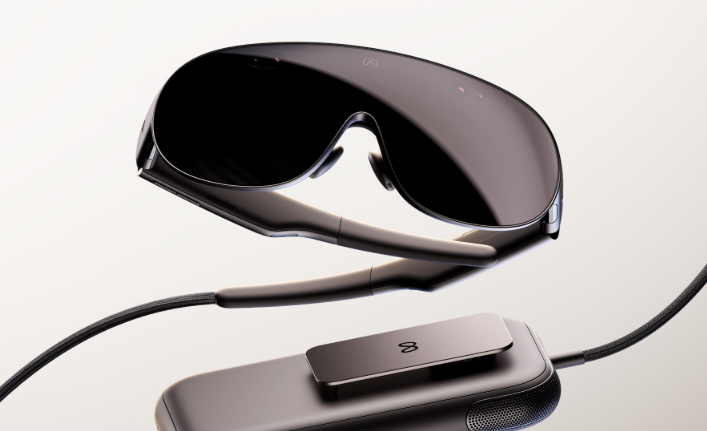
by Meta last week unveiled one of their most exciting VR products to date – the Meta VR Glasses. Whilst being branded as the first VR glasses, and weighing only 100g, commentators have noted that the chief weakness is the rather limited FOV – only 70 degrees, compared to the 110 degrees of the Meta Quest 3. However, the Meta VR Glasses shine when it comes to passthrough mixed reality experiences. Not only do they have the genuine glasses form factor instead of a bulky headset, the Meta VR Glasses has a much better resolution, with a pixel density of up to 37 PPD (depending on how it is measured). Whilst the colored passthrough of the Quest 3 was a huge upgrade from the low-resolution b&w of its predecessor, mixed reality porn fans were still sometimes disappointed by the occasional image warping and lack of fidelity. These problems should be a thing of the past with the new glasses. Passthrough VR porn movies will be incredible viewed with these glasses, and because the glasses will support the WebXR standard, the volumetric 6DoF AR porn scenes of Braindance will be playable and should look amazing.

Comparison with the XREAL Aura Glasses
The Meta VR Glasses wont have it all their own way when it comes to competing for AR porn fans. The XREAL Aura will launch this Fall, and really are a pair of AR glasses rather than an immersive VR device that does passthrough. So the possibilities for AR porn experiences should be far greater on them, although
XREAL Aura vs Meta VR Glasses
Key specifications of two forthcoming glasses-style spatial computers. Both use a split design (lightweight frames plus a pocket compute puck) and Qualcomm’s Snapdragon Reality Elite, but they take very different approaches to seeing the real world. Specs are based on manufacturer announcements and reporting as of late September 2026; some XREAL Aura details (final price, exact brightness) may still change before launch.
| Specification | XREAL Aura | Meta VR Glasses |
|---|---|---|
| Price | Up to $1,500 (expected; final price TBD) | $1,299.99 (US) |
| Availability | Fall 2026 | Spring 2027 |
| Category | Optical see-through AR / spatial computing glasses | Glasses-style VR / mixed reality headset |
| Weight (on face) | Under 95 g | About 100 g |
| Compute puck | Yes (wired); ~4,455 mAh battery | Yes (optical tether); about 300 g |
| Display | Sony Micro-OLED, X Prism optics | “5K Infinite Display” dual Micro-OLED, pancake lenses |
| Resolution (per eye) | 1920 × 1200 | 2412 × 2288 (~5.5 MP) |
| Sharpness | Not officially published as PPD | 37 pixels per degree |
| Refresh rate | Up to 120 Hz | Up to 120 Hz |
| Field of view | 70° (optical see-through) | 70° H × 66° V (~87–88° diagonal) |
| How you see the world | True optical see-through + electrochromic dimming (5 levels) | Full-color camera passthrough; optional light blockers for fuller immersion |
| HDR / cinema features | Not a headline spec | Dolby Vision, IMAX Enhanced certified |
| Tracking | 6DoF + hand tracking (world-facing cameras) | 6DoF + hand, eye (4 cameras), and face tracking |
| Cameras | 2× tracking + 1 high-res camera with privacy LED | Color passthrough cameras + eye-tracking cameras; depth sensing |
| Input | Hands, voice, puck touchpad; Bluetooth keyboards/controllers | Eyes, hands, voice; optional Touch Plus / Quest controllers |
| Vision correction | Insertable prescription lenses; IPD sizes M (60–66 mm) and L (66–72 mm) | Zenni Optical inserts; manual IPD 56–70 mm; Small and Large frames |
| Audio | Bose EQ-tuned spatial audio + 4-mic array | Dolby Atmos spatial audio in the frames |
| Processor / memory | Snapdragon Reality Elite (puck) + XREAL X1S co-processor (glasses); 12/256 or 16/512 GB | Snapdragon Reality Elite in puck; 12 GB RAM, 128 GB + microSD up to 1 TB |
| Software / ecosystem | Android XR + Gemini; Google Play + XR apps; DP-in from PC/laptop/handheld | Horizon OS / Quest store; hologram calling; Xbox Cloud Gaming; virtual Mac/PC display |
| Battery / charging | 4,455 mAh in puck; USB-C up to 65W; DP-in on second port | Up to ~3 hours media; 45W fast charge (can charge while in use) |
| Key strengths | Natural optical AR presence, earlier launch, Gemini + Android apps, dimmable see-through | Much sharper panels, Quest library, eye tracking, IMAX/Dolby cinema, true VR immersion |
True 6DoF AR vs mixed-reality VR (Grok Explains)
Both devices track 6DoF (head rotation and position), so virtual windows and objects can stay anchored in space as you lean or walk. The difference is how they blend digital content with the real world.
XREAL Aura is optical see-through AR. You look through the lenses at the actual room; digital content is overlaid on that view. Electrochromic dimming can darken the lenses for contrast, but the real world is still seen optically, not reconstructed by cameras. That is the closer match to “true 6DoF AR content” sitting in your physical space while you remain socially present.
Meta VR Glasses are a glasses-shaped VR/MR headset. The real world is shown via full-color camera passthrough on opaque Micro-OLED panels. That enables richer contrast, true occlusion, full VR games from the Quest catalog, and cinema-style immersion (including optional light blockers). It is still 6DoF spatial computing, but it is mixed reality through cameras rather than optical AR.
XREAL Aura is optical see-through AR. You look through the lenses. Light from the room reaches your eyes directly. The Micro-OLED image is added on top of that real view (prism / birdbath-style optics). Electrochromic dimming can darken the glass so virtual content pops more, but you are still seeing the physical world with your own eyes, not a camera feed.
Meta VR Glasses are video see-through VR/MR. The panels are high-resolution Micro-OLEDs behind pancake lenses. What you “see” of the room is a camera reconstruction (full-color passthrough). Optional light blockers close the gaps so it can become a more enclosed VR headset. That is why Meta can sell contrast, occlusion, IMAX/Dolby cinema, and the Quest game library: the display can take over the whole image.
Those two pipelines feel different even when the spec sheets look similar (both ~70° FOV, both pucks, both Snapdragon Reality Elite):
Latency and presence. Optical AR has no camera-to-display delay for the real world. Passthrough always has some delay and processing. Your hands and the room can feel slightly “video-like” on Meta; on Aura they stay optically live.
Contrast and immersion. Passthrough wins for movies and full VR because the panels can go black and hide the room. Optical AR struggles to make virtual objects fully opaque or cinematic in a bright room.
Social presence. People can see your eyes through Aura. Meta’s design is closer to a tiny headset: you are looking at screens, with cameras facing out.
What “anchored AR” means. Both can pin a window in space. On Aura that window sits in the actual room you are seeing. On Meta it sits in a reconstructed room. Same 6DoF idea, different sensory path.
So the honest labels are:
| XREAL Aura | Meta VR Glasses | |
|---|---|---|
| Best description | Optical AR glasses | Glasses-shaped VR/MR headset |
| Real world | Direct (optical) | Indirect (cameras) |
| Strength | Presence, everyday awareness | Sharpness, immersion, Quest software |