
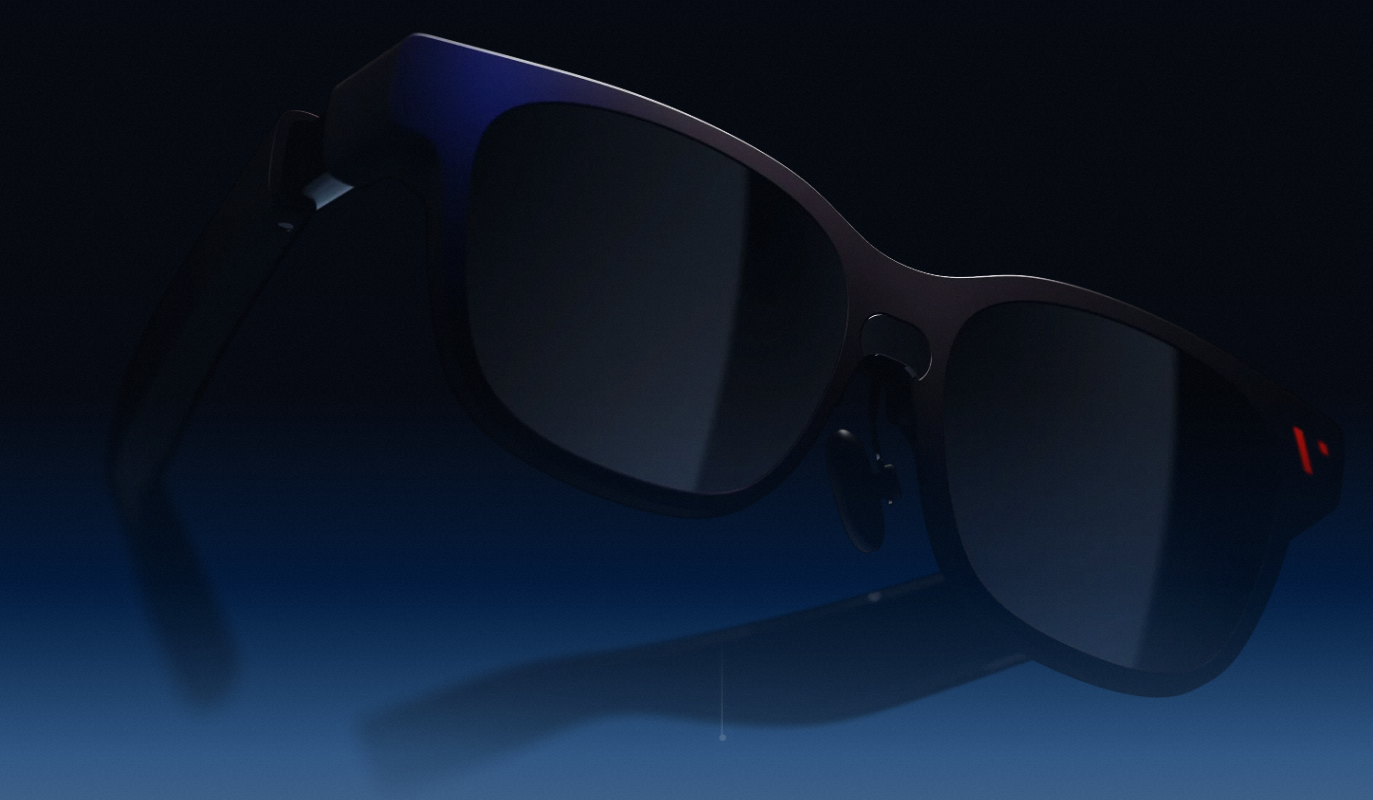
 by
by Viture is one of the companies pioneering “AR glasses” and recently made two new noteworthy announcements. The first was the launch of the Viture Pro 2, the follow-up to their successful flagship range of glasses. However, it appears that, like all of the present “AR glasses”, it’s really still capable of only of displaying virtual screens and 2D graphics, rather than true augmented reality content. Mainly, it seems an incremental advance in terms of resolution, FOV, and other technical specifications. One exciting feature that the Viture glasses (along with XREAL) do possess is the ability to convert 2D video to 3D in real time. So you can watch any 2D adult video in 3D, on a large virtual screen, via a pair of lightweight Viture glasses (and the Pro 2 is even lighter than the original, at only 63g). Not quite AR porn, but still something that should interest AR porn fans. And Viture’s second announcement is relevant to this, as it concerns an update to its Pro Neckband (used as a convenient controller for the glasses) which means it’s even easier to play the 3D feature.
More exciting for AR porn fans is the potential of the new glasses from Viture’s main rival XREAL. The XREAL Aura will support AndroidXR, which itself supports WebXR, making true adult AR content such as the videos of BraindanceVR, potentially viewable on the glasses. The first pair of AR glasses to run the powerful new Snapdragon XR chip, it seems to be much closer to what AR porn fans have been waiting for, and should be available in most North American and European countries in the Fall. Tech vloggers on YouTube who have enjoyed early access seem to have been genuinely blown away by the glasses. However, AR glasses (or XR glasses if you prefer) are still highly expensive pieces of kit, with the XREAL Aura retailing at around $1,500 USD. Furthermore, as mentioned with the Viture glasses, you also need to spend extra on add-ons such as the Virtue Neckband or the XREAL Pro Beam to really be able to control the glasses with ease (essential for masturbating with them).
Viture Pro 2 and XREAL Aura AR Glasses Comparison
Viture Pro 2 vs XREAL Aura
Key specifications of the forthcoming XR glasses. Specs based on manufacturer announcements and reviews as of August 2026. Some XREAL Aura details (final price, exact brightness) may be refined closer to Fall 2026 launch.
| Specification | Viture Pro 2 | XREAL Aura |
|---|---|---|
| Price | $299 (glasses only) | Up to $1,500 (expected) |
| Availability | Available now | Fall 2026 |
| Weight (glasses) | 63 g | Under 95 g |
| Architecture | Tethered (USB-C to phone/PC/dock) | Split: glasses + compute puck |
| Display | Sony Micro-OLED | Sony Micro-OLED (X Prism optics) |
| Resolution (per eye) | 1920 × 1080 | 1920 × 1200 |
| Refresh Rate | Up to 120 Hz | Up to 120 Hz |
| Field of View | 50° | 70° |
| Peak Brightness | 1,600 nits | Not fully detailed (electrochromic dimming) |
| Optics / See-through | Birdbath / Prism (virtual display focus) | Optical see-through with electrochromic dimming (5 levels) |
| Vision Correction | Built-in diopter dials (0 to −5.0D per eye) | Insertable prescription lenses |
| Tracking | Primarily 0/3DoF (head rotation); limited spatial via accessories/software | Native 6DoF + hand tracking (world-facing cameras) |
| Cameras / Sensors | None (camera-free) | 2× tracking cameras + high-res camera (privacy LED) |
| Audio | Built-in spatial speakers (Harman-tuned) | Bose EQ-tuned spatial audio + 4-mic array |
| Processor / Platform | Depends on connected device + optional dock/neckband | Snapdragon Reality Elite (puck) + X1S spatial co-processor (glasses); Android XR + Gemini |
| Battery | None in glasses (powered by source device/dock) | 4,455 mAh in compute puck |
| Key Strengths | Ultra-light, very bright private screen, built-in myopia adjustment, affordable, excellent for media/gaming | True spatial computing, wide FOV, 6DoF AR, hand tracking, full Android XR ecosystem |
True 6DoF AR Content
XREAL Aura is designed for genuine 6DoF (six degrees of freedom) spatial AR. With world-facing cameras, it tracks both head rotation and position in space, so digital content can stay anchored in the real world as you walk, lean, or move. It also supports hand tracking and full Android XR spatial apps.
Viture Pro 2 is primarily a high-quality tethered virtual-display device. It lacks cameras and native positional tracking, so it does not support true 6DoF AR experiences where virtual objects remain fixed in physical space. Content typically follows your head (or offers limited 3DoF stability via software/accessories). It excels at bright, sharp private screens for media, gaming, and productivity rather than world-anchored AR.
